
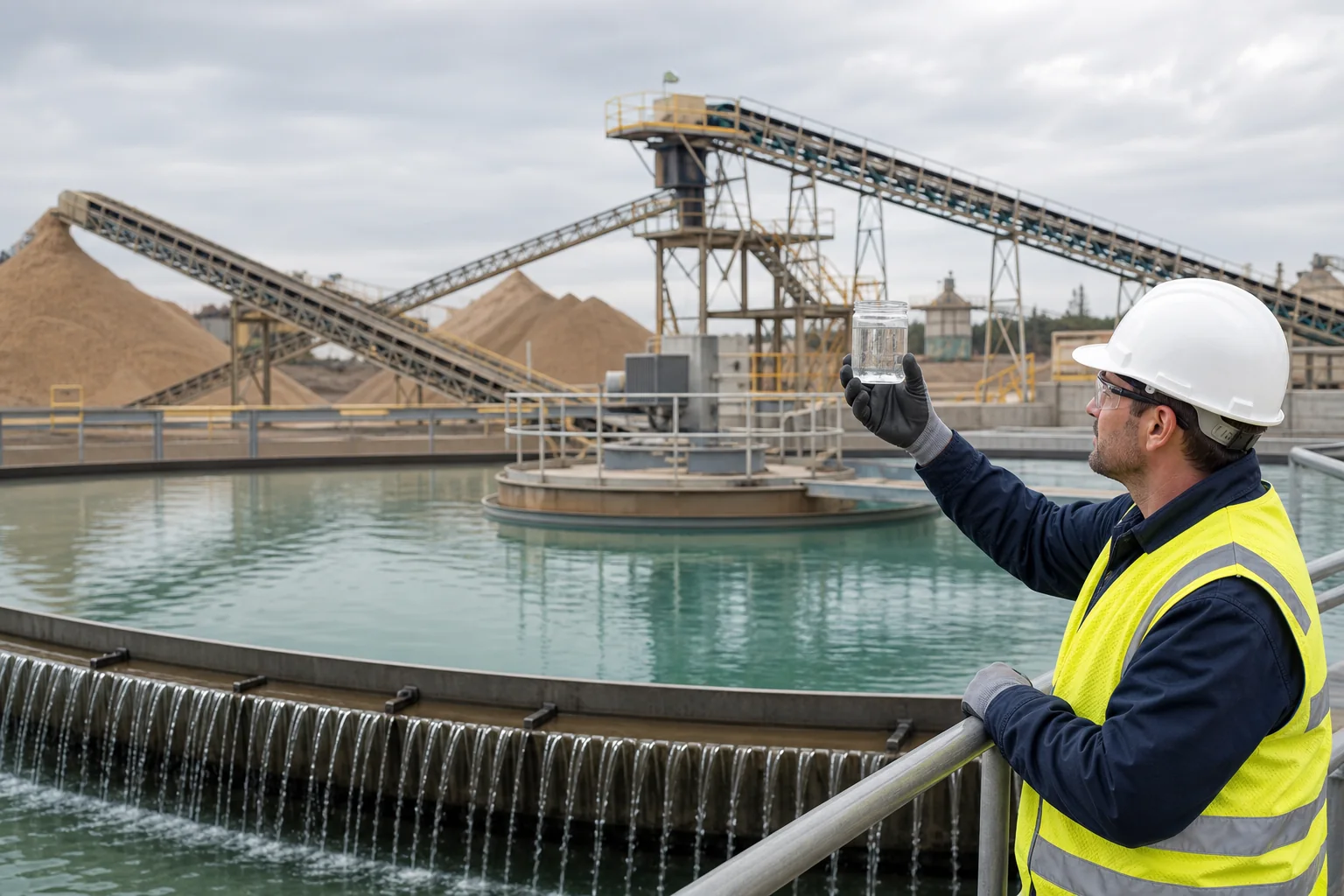
Sand and aggregate washing produces fines whose clay content, surface chemistry and concentration change with the deposit and operating campaign. Anionic PAM can accelerate settling, but the circuit must be tested for water reuse, sludge withdrawal and filter performance.
Characterize the changing fines
Record feed source, silt and clay fraction, wash-water flow, clarifier feed solids, pH, conductivity and hardness. Note crusher dust, natural clay seams and any coagulant. Sample after the circuit has reached its normal recycle condition.
A fresh-water bench test may rank products differently from accumulated process water. Compare both when salts and ultrafines build during closed-loop operation.
Measure clarifier and sludge outcomes
Use settling columns to compare interface speed, supernatant turbidity and final sediment volume. In the plant, record overflow clarity, blanket stability, sludge withdrawal, rake load where applicable and water available to washers.
If sludge is filtered, include filtrate, drainage, cake release and cycle time. A product that clears the clarifier but creates difficult sticky sludge may shift cost downstream.
Manage preparation and feed
Dry anionic PAM requires controlled wetting and maturation. Confirm feeder output, water flow, tank residence and solution age. Use secondary dilution where it improves distribution, while avoiding destructive shear after floc forms.
Dose against dry solids when possible. Fixed pump output can underdose during high-fines periods and overdose after the feed clears.
Approve the circuit window
Retain product code, active dose band, feed-solids range, water condition, clarifier measurements and filter observations. The sand-washing operating guide connects these measurements to daily adjustments.