
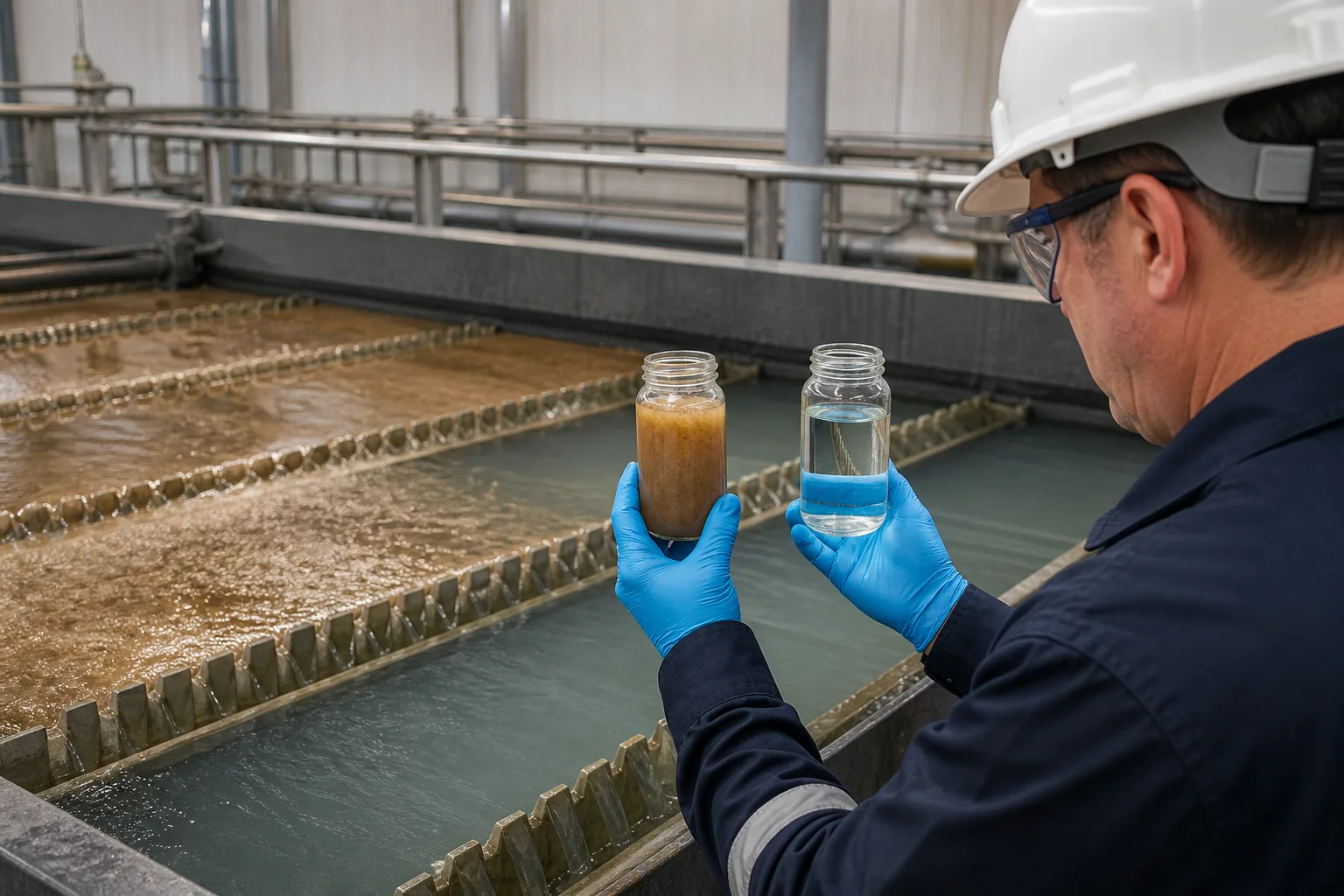
Clarification-grade anionic PAM is screened where the primary value is rapid solids separation and consistently clear overflow. The choice must remain stable when feed turbidity, particle size and coagulant demand move within the normal range.
Define the clarification endpoint
Record raw-water or slurry flow, suspended solids, particle character, pH, conductivity and temperature. Select a repeatable overflow measurement such as turbidity or suspended solids, and pair it with settling time, sludge-volume or blanket behavior.
A clear beaker after a long wait is not enough when the clarifier has limited residence. Very rapid large floc can also be fragile at the feedwell or create a bulky blanket that restricts capacity.
Place coagulant and polymer deliberately
PAC, alum or ferric may first destabilize fine particles. Anionic PAM can then bridge the formed microfloc. Keep coagulant dose and rapid-mix condition fixed while screening polymer; afterwards, optimize the combined sequence with a small matrix.
If the process uses no inorganic coagulant, verify a real response before increasing polymer repeatedly. Flat response can indicate an unsuitable charge family, poor solution preparation or insufficient counter-ions for bridging.
Recognize the boundaries
Underdose often leaves slow-settling fines or a diffuse interface. Overdose can restabilize the suspension, form light stringy floc or increase carryover. Locate both boundaries and choose a controllable middle range rather than the single clearest jar.
Confirm the finalist on the plant clarifier, including feedwell shear, blanket stability, sludge withdrawal and water-recovery requirements. Compare active polymer mass per dry solids treated.
Send useful sample data
Provide source water or slurry, solids concentration, particle description, current coagulant, mixing sequence, clarifier type, overflow target, flow, monthly polymer demand and destination. These inputs allow a focused product pair or trio rather than an unrelated catalogue set.