
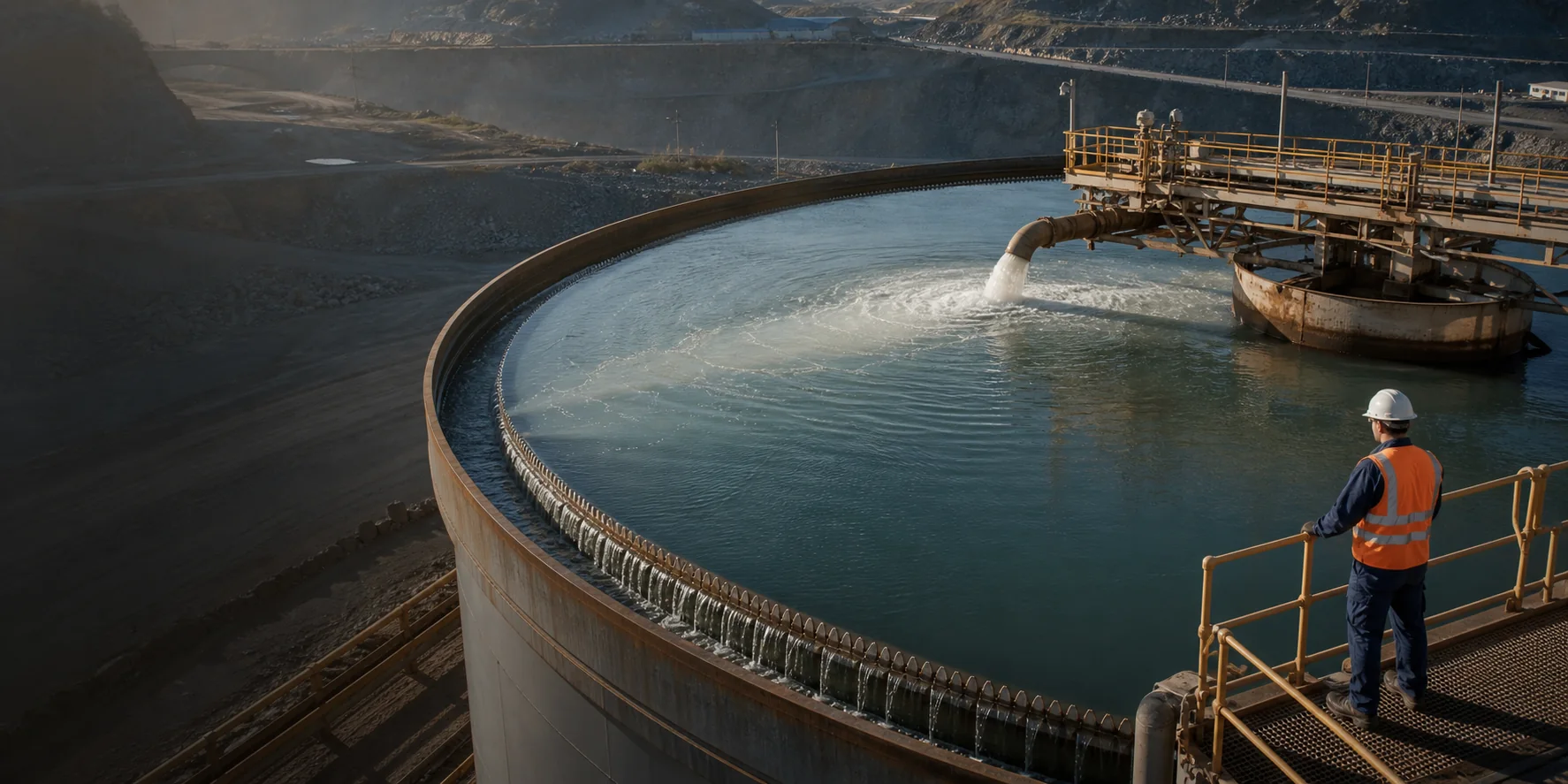
Anionic PAM application fit begins with particle surfaces, dissolved chemistry and the separator. Industry name is useful context, but representative testing determines whether the negative-charge family produces a stable operating window.
Three commercial application paths
Mining tailings work balances settling flux, recycled-water quality and underflow handling. Sand-washing circuits focus on fines capture, clarifier capacity and closed-loop water stability. Industrial clarification may use anionic PAM after PAC, alum or ferric to enlarge precipitated microfloc.
Each application page defines the feed data, trial observations and scale-up measurements needed before product approval.
Do not infer the polymer from the industry alone
Clays, metal hydroxides, silica, carbonates, coal fines and mixed industrial precipitates can respond differently. pH, hardness, salts, dispersants, collectors and coagulants alter adsorption and bridging. A cationic or nonionic candidate may outperform anionic PAM on a particular feed.
Use charge as a screening decision, not a purchasing shortcut. The anionic versus cationic PAM guide sets out a controlled comparison.
Carry evidence from bench to plant
Keep solution preparation, active dose and mixing consistent during bench work. At plant scale, account for injection distribution, residence, shear, separator settings and recycle accumulation. Approve a range that operators can control under normal variation.