
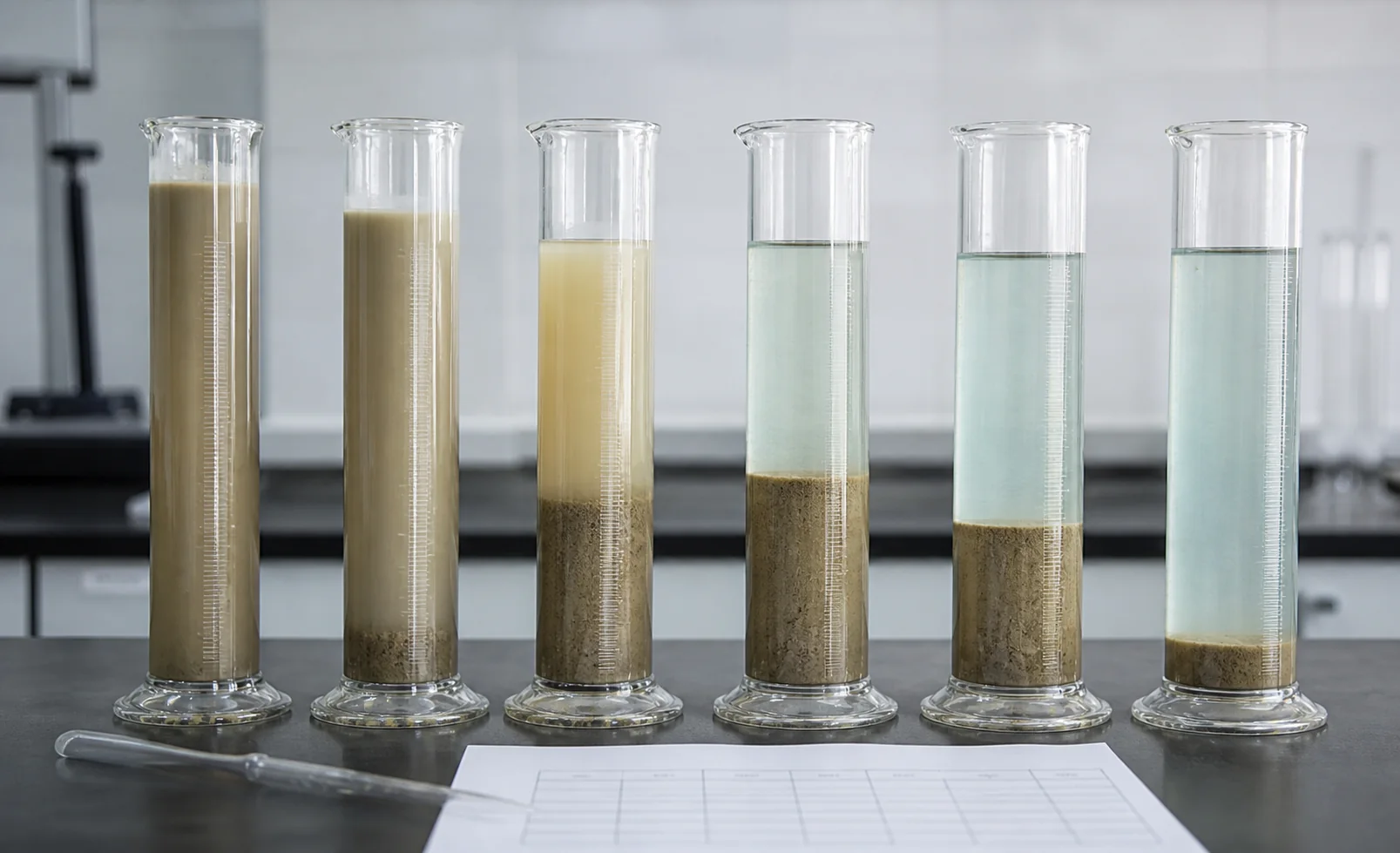
Anionic and cationic PAM differ in charge interaction, but wastewater or slurry names do not determine the winning family. Surface condition after upstream chemistry, polymer architecture and separator demands must be tested together.
Start with the formed solids
Mineral particles and inorganic precipitates are often screened with anionic PAM, especially when multivalent ions or a coagulant create bridging conditions. Biological and organic sludge is often screened with cationic PAM because many surfaces carry negative demand.
These are starting hypotheses, not universal rules. Mixed industrial solids, clays, surfactants, oils, salts and upstream chemicals can reverse the expected ranking.
Account for coagulation
PAC, alum, ferric, lime or pH adjustment changes particle surface and creates new solids. The appropriate polymer is selected after that condition is established. Adding a strong coagulant may make an anionic bridge effective even when raw particles were also negative.
Keep coagulation fixed during the ionic-family screen. Include a coagulant-only control so polymer contribution is measurable.
Compare architecture as well as charge
Products within one ionic family differ in charge range, molecular size, branching and form. A weak result from one code does not reject every anionic or cationic product. Use a focused matrix that explains why each candidate differs.
Prepare every product according to its documented method and normalize active dose. Equal solution volume is not a fair comparison when active content or stock concentration differs.
Use application-specific endpoints
For mineral clarification, measure settling and overflow. For tailings thickening, include compaction, shear and underflow. For organic-sludge dewatering, include filtrate or centrate, cake, capture and equipment behavior.
A large beaker floc is not a universal endpoint. Rank the family on process result and operating window.
Recognize underdose and overdose
Both ionic families can leave fines when underdosed and can worsen separation when overdosed. Build a dose curve for each candidate rather than comparing them at one arbitrary point. Record sticky solids, haze, restabilization, drainage and resilience.
If neither family performs, recheck preparation, precipitation, mixing and sample representativeness before expanding the set.
Consider use constraints
Product selection must follow local regulations, the SDS, residual-monomer requirements and intended water or land use. Do not substitute industrial wastewater experience for an agricultural, potable or discharge authorization.
USDA guidance for irrigation erosion control specifically distinguishes water-soluble anionic products from cationic products in that use. That guidance should not be generalized into a rule for every industrial separator.
Approve the proven code
Retain feed chemistry, coagulation, product and lot, solution method, active dose, mixing and separator results. Use the anionic PAM product selector when evidence supports the negative-charge family; otherwise continue the ionic screen.
Use a blind or coded first comparison
Where practical, identify samples by neutral codes and keep product family information on a separate sheet until the first observations are recorded. Prepare each product under its correct method while holding active dose and test sequence consistent. Coding reduces the tendency to interpret mineral solids as automatically anionic or organic solids as automatically cationic.
After decoding, connect the observed response to charge and architecture. The explanation should follow the evidence, not replace it.
Account for downstream water and solids
The preferred family must meet both water and residual-solids needs. Measure overflow or filtrate, settling, compaction, cake, capture and cleaning as applicable. Also consider whether recycled water returns polymer, coagulant or dissolved ions to an upstream process.
A product that creates clear water but sticky unpumpable solids may increase total cost. A product with drier cake but unacceptable fines loss is also incomplete.
Write a charge-selection conclusion
Record which families and products were tested, active dose curves, coagulation state, preparation, mixing, feed properties and separator endpoints. State why the selected code passed and why alternatives failed. Avoid conclusions such as anionic is stronger or cationic is always for wastewater.
Set conditions that trigger a new comparison: major feed or pH change, new coagulant, separator replacement, persistent lot investigation or a material change in recycle chemistry.
Send an evidence-based RFQ
Provide the current product, charge family, active dose, blank and alternative results, equipment, required endpoint, monthly quantity and destination. A supplier can then refine a molecular or charge range without restarting the evaluation from unrelated products.
If evidence rejects anionic PAM, do not force an anionic quote merely because the domain phrase matched the original search. The correct technical result protects the process and the buyer.