
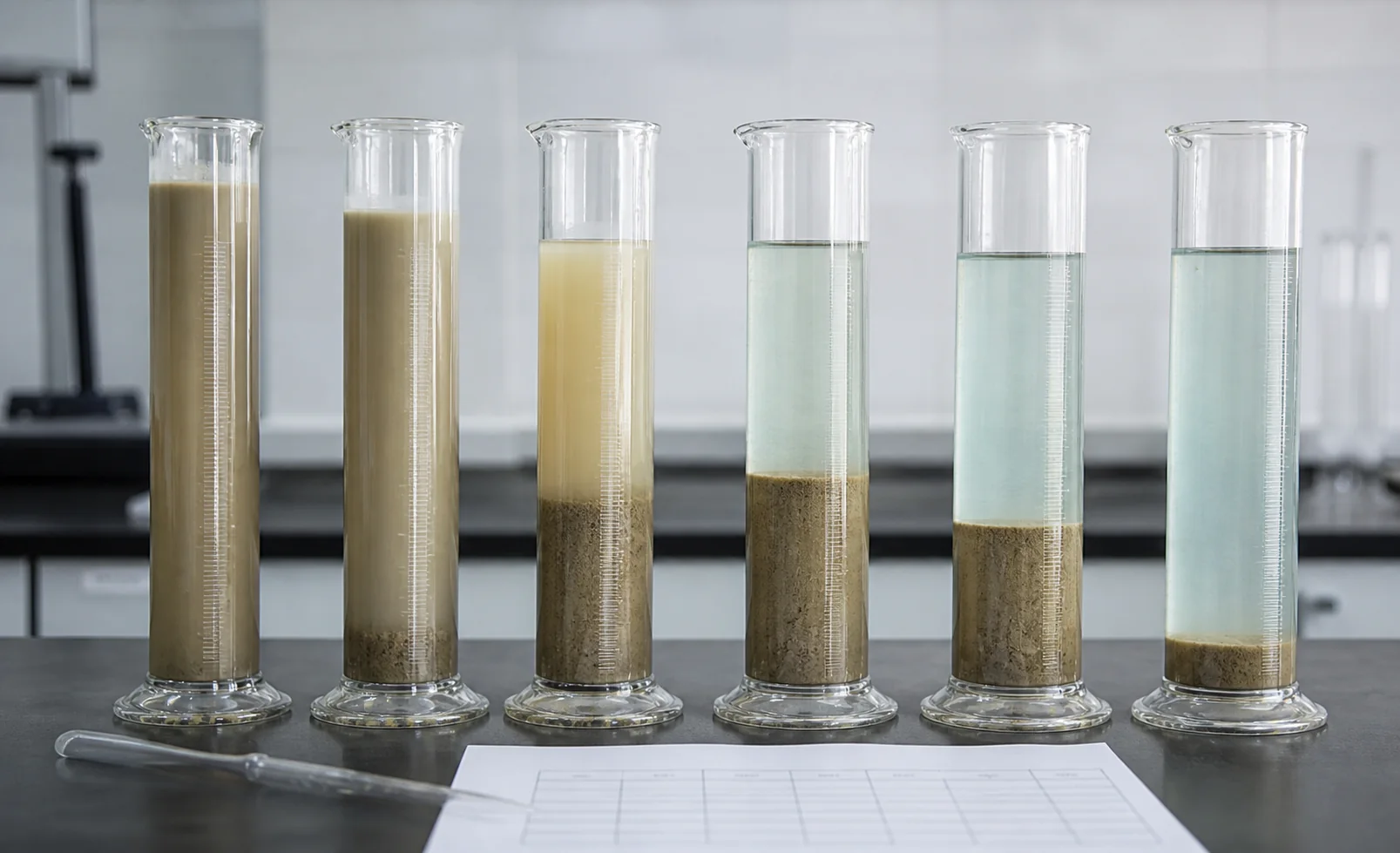
Anionic PAM is a negatively charged, water-soluble polyacrylamide family used to bridge suspended mineral and inorganic solids. A useful product code is selected from the actual slurry and separator, not from molecular weight or anionicity alone.
Choose the duty before the grade
Clarification work prioritizes fast formation of settleable floc and low overflow turbidity. Thickening work must also protect underflow density, rake behavior and water recovery. Filtration work asks whether the floc drains and releases without blinding cloth or carrying fines into filtrate.
Use the three product paths below to define the acceptance endpoints. A candidate can fit more than one path, but the plant trial must rank it against the operating objective that controls cost or production.
Screen charge and molecular architecture together
Anionic charge influences interaction with particle surfaces and dissolved multivalent ions. Molecular size and architecture influence bridging, floc size and shear response. A higher value is not a universal upgrade. Compare a focused set under the same preparation, active dose, mixing and feed condition.
Record pH, conductivity, hardness, dissolved metals, mineralogy, particle-size distribution, solids concentration and any PAC, alum, ferric or lime addition. Those variables can change the useful family or injection point.
Approve an operating window
Build a dose curve that includes underdose and overdose. Measure settling rate, interface shape, supernatant or overflow quality, floc resilience and the downstream endpoint. Retain the product code, lot, preparation method and test sheet with the purchasing specification.
For a focused sample set, send the feed and process record through the anionic PAM trial worksheet.