
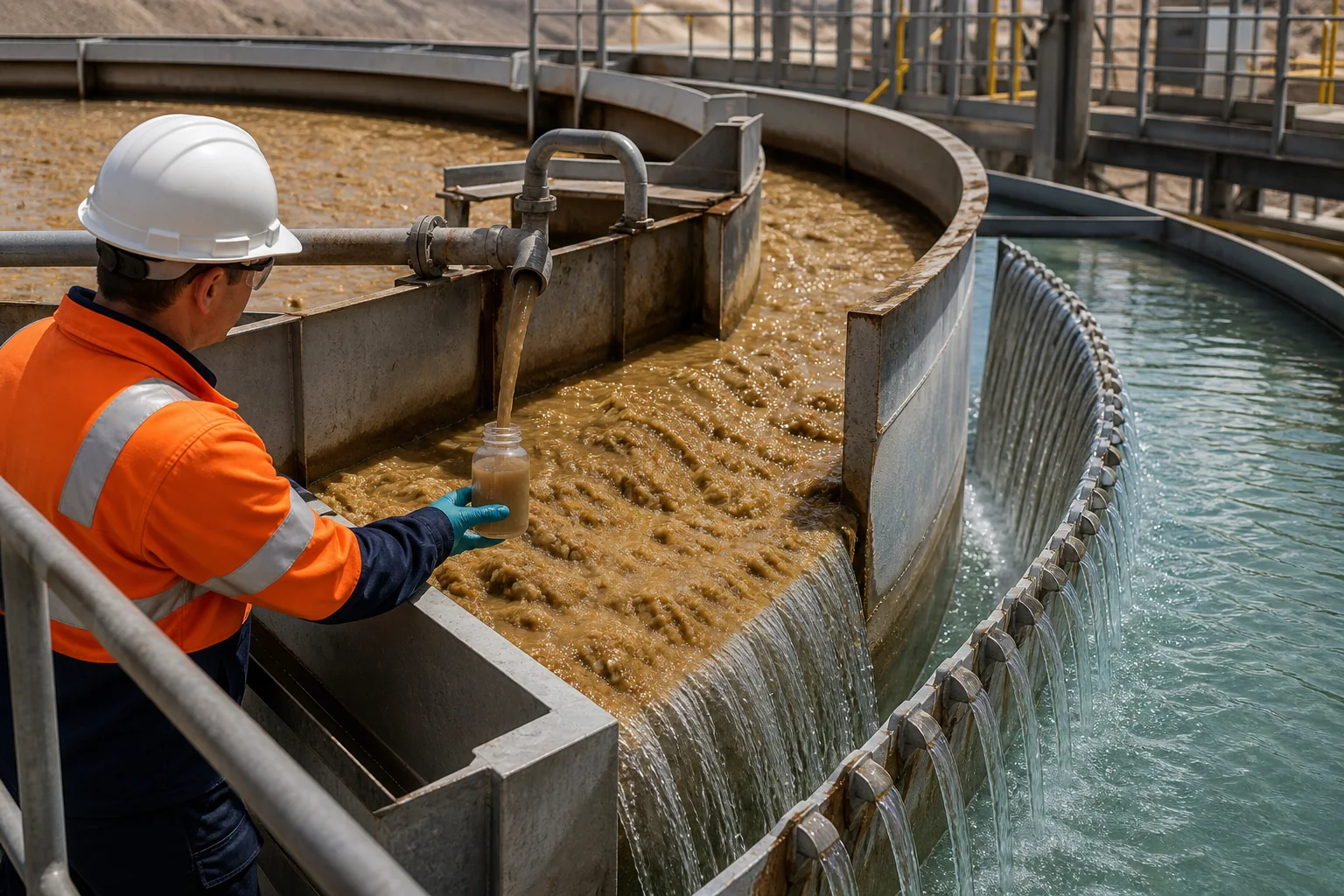
Thickening-grade anionic PAM must create floc that settles at the required solids flux while producing a manageable underflow and reusable overflow. The largest floc in a cylinder is not automatically the best thickener product.
Characterize the mineral feed
Record ore or aggregate source, mineralogy where known, particle-size distribution, clay fraction, solids concentration, pH, conductivity, hardness and process reagents. Use fresh representative slurry because fines distribution and surface chemistry can shift during storage.
Test difficult operating periods as well as average feed. A product with a slightly lower peak settling rate may be more valuable if its response remains stable across the expected feed envelope.
Measure the full thickening response
Run timed settling cylinders or a suitable dynamic test. Record initial settling velocity, interface definition, supernatant clarity, final bed volume and compaction behavior. Apply a controlled shear step when the feedwell or transfer system is energetic.
For plant work, include overflow solids, bed level, rake torque or pressure, underflow density, pumpability, throughput and water recovery. Polymer cannot be ranked from overflow clarity alone.
Control dose and addition point
Prepare every candidate with the same water, concentration, hydration and age. Compare active dose on dry solids. Test dilution and injection distribution because a viscous stream can short-circuit through the feedwell and create local overdose.
Increase dose in measured steps and allow residence time before sampling. If settling improves but compaction worsens, examine floc structure, molecular range and addition strategy rather than continuing to raise dose.
Write the purchasing basis
Approve the exact grade code, product form, preparation method, dose window, feed range and acceptance endpoints. Include COA method alignment, packaging, destination and retained-sample procedure on the quality and supply record.