
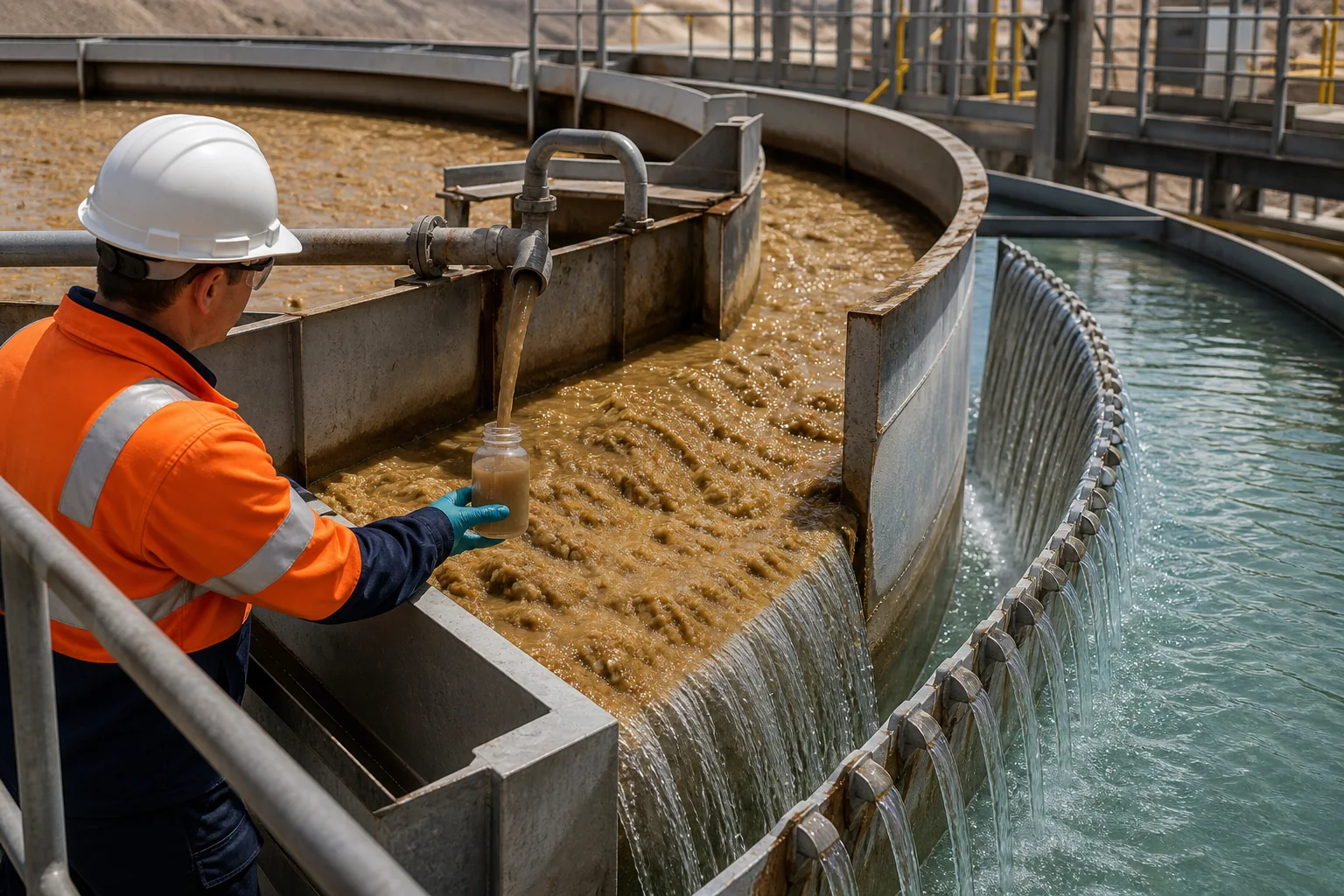
Mining tailings can contain a broad particle-size range, reactive mineral surfaces, clays and residual process reagents. Anionic PAM is a common screening family, but the approved grade must be demonstrated on the ore, water and thickener circuit in question.
Build a representative feed envelope
Record ore campaign, grinding condition, solids concentration, particle-size distribution, mineralogy or clay indicators, pH, conductivity, hardness and flotation or leaching reagents. Sample steady and difficult periods. Recycled water should be represented because dissolved species can accumulate.
Avoid ranking polymers on a settled sample that has lost its finest fraction. Homogenize carefully without applying uncontrolled shear.
Use settling tests as a decision screen
Prepare products consistently and dose on active mass per dry solids. Measure interface velocity, supernatant turbidity, floc appearance, compaction and response after defined shear. Include low and high points around the useful range.
A fast initial interface with cloudy supernatant or poor final compaction may not support the plant objective. Compare the complete response and repeat finalists before scale-up.
Translate to the thickener
At plant scale, document solids flux, dilution, feedwell energy, overflow quality, bed level, rake condition, underflow density and pumpability. Allow each dose change to reach steady state. Do not optimize rake and polymer simultaneously during the first product comparison.
Review recycle-water effects on flotation, washing or other upstream steps. Clear appearance alone does not establish that dissolved chemistry is acceptable.
Send the production case
Provide the ore and slurry record, thickener operating data, present polymer and dose, overflow and underflow targets, monthly demand, packaging and destination. Use the tailings settling-test procedure to organize the comparison.