
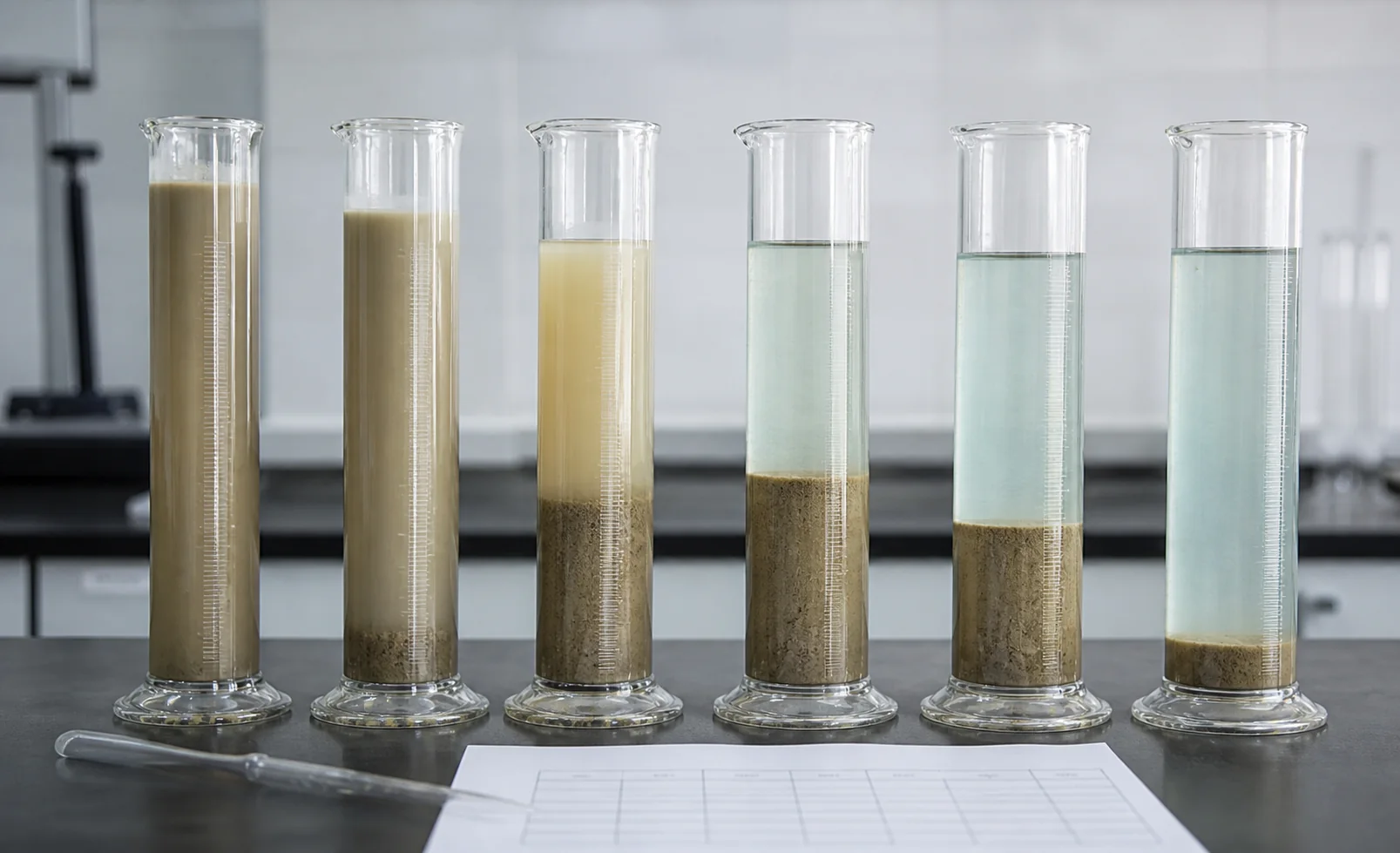
Cloudy supernatant or overflow after anionic PAM does not prove that the whole product family is wrong. A fixed diagnostic sequence separates feed change, delivery failure, underdose, overdose, coagulation and separator effects before samples are replaced.
Freeze the evidence
Record time, feed source, solids, pH, conductivity, temperature, coagulant, polymer product and lot, stock concentration, actual flow, mixing and separator settings. Collect representative feed and overflow samples before making several simultaneous adjustments.
Note whether failure was abrupt, gradual or periodic. A sudden change often directs attention to an empty tank, feeder interruption, blocked injection or process slug; a gradual shift may follow feed fines, recycle chemistry or calibration drift.
Verify the dose basis
Recalculate active polymer against current water flow or dry solids. A higher solids load can create underdose at the same pump setting. A lower load can create overdose. Calibrate the pump and check that secondary dilution has not been mistaken for active stock flow.
Run a small dose curve around the current condition. Improvement with increasing dose supports underdose; improvement followed by deterioration identifies a boundary. Flat response points toward preparation, mixing or product fit.
Inspect solution preparation
Check powder induction, water flow, tank level, maturation, solution age, undissolved fisheyes and feeder calibration. Confirm that valves and pumps deliver intended solution to the injection point.
Do not double dose to compensate for visibly defective stock. Prepare a controlled fresh solution and compare it with plant stock on the same feed.
Review coagulation and ionic fit
In coagulant-aid service, verify pH and PAC, alum or ferric before changing polymer. Poor precipitate formation leaves particles that bridging cannot repair. Excess coagulant can also shift surface condition and demand.
If a correctly prepared anionic product gives little response across a controlled range, test adjacent molecular or anionic ranges and another ionic family. The solid surface and water chemistry decide useful charge.
Check mixing and shear
Polymer must distribute before floc growth but excessive energy after bridging breaks floc. Inspect injection dilution, mixing zone, pipe restrictions, valves and feedwell energy. Reproduce a defined shear challenge in the bench test when the plant path is severe.
A good jar test combined with poor plant overflow often directs attention to delivery, contact or separator hydraulics rather than product identity.
Inspect the separator
Confirm flow, residence, weirs, feedwell, blanket or bed level, sludge withdrawal and short-circuiting. In sand circuits, accumulated fines can exceed clarifier capacity. In thickeners, unstable bed or rake condition can release solids even when incoming floc is suitable.
Restore a mechanical baseline before ranking products. Record the corrected operating window so the next event can be compared against evidence.
Escalate with a complete packet
Send feed and water data, active-dose calculation, preparation log, dose curve, photographs or measurements, separator settings and time pattern. Review the clarification-grade acceptance endpoints before requesting replacement.
Read the solids pattern, not only one number
Fine uniformly suspended solids suggest a different cause from intermittent large floc carryover. Sample at consistent points after steady state and note whether the failure follows a feed surge, blanket movement, sludge withdrawal or pump cycle. Where possible, combine turbidity trend with suspended solids or a defined settled-sample observation.
A clear grab sample can miss periodic loss. Time-stamped observations help separate continuous chemistry failure from hydraulic or control events.
Use a cause-and-response table
Before each change, write the hypothesis and expected result. A measured dose increase should improve capture if underdose is dominant; improvement followed by haze suggests the useful window was crossed. A fresh correctly prepared stock should improve response if the day tank is defective. A coagulant-only control tests whether precipitation has shifted.
This simple discipline prevents every outcome from being explained after the fact and reduces simultaneous adjustments by different shifts.
Set recovery and handover rules
Define acceptable overflow, underflow or sludge withdrawal, equipment load and product-flow limits before troubleshooting. If a step worsens a critical value, return to the documented stable setting. Keep equipment and environmental limits above the desire to complete a polymer test.
At handover, record which checks were completed, their results, current feed and chemical condition, next planned step and the time when a change should reach the sample point. This prevents repeated or contradictory actions.