
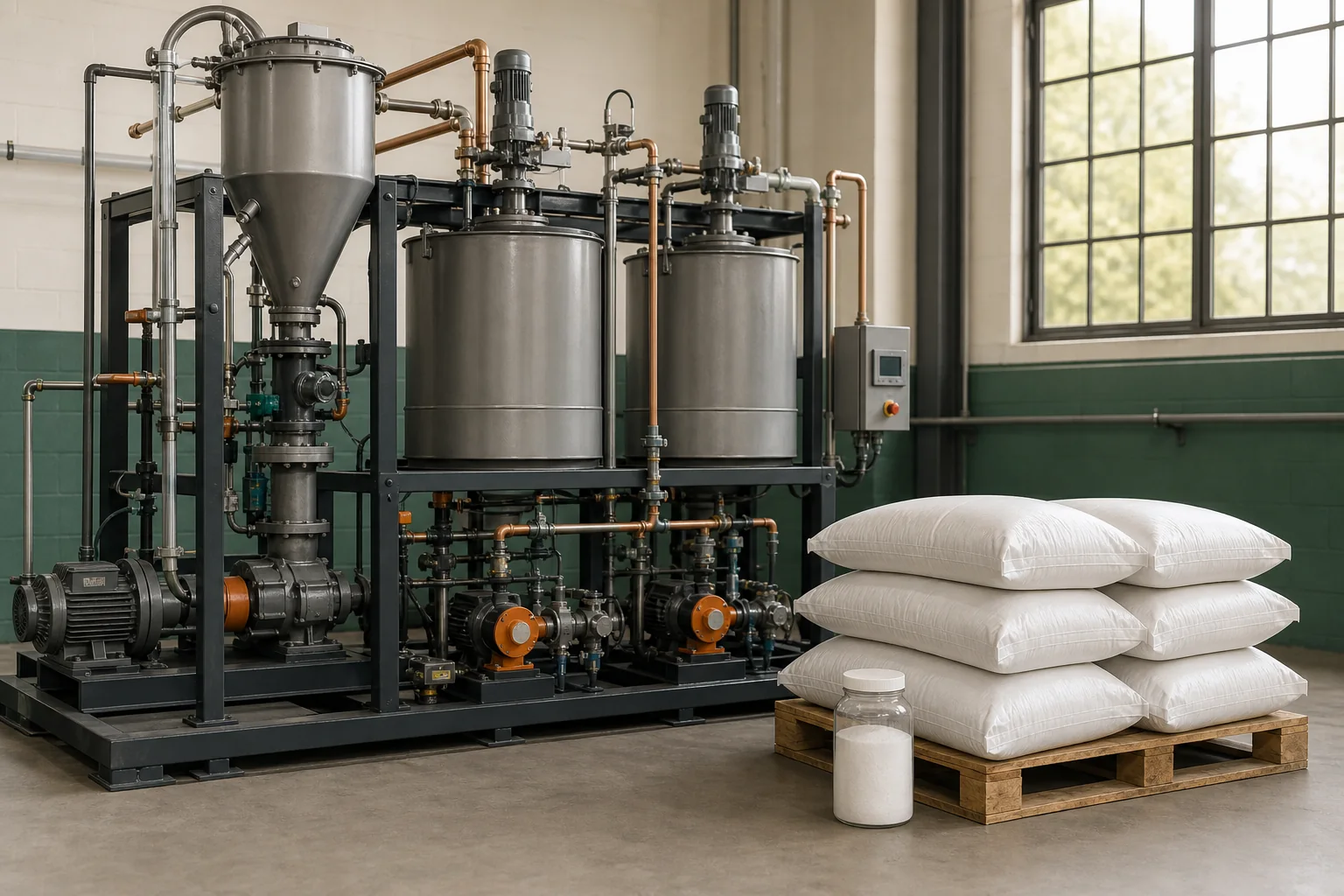
A suitable anionic PAM can appear weak when powder forms fisheyes, residence time collapses or a viscous stock fails to distribute. Preparation should be verified before dose is increased or a grade is rejected.
Verify water and feeder inputs
Record make-down water source, temperature, pH, conductivity and hardness where relevant. Confirm water flow independently and calibrate dry feeder output at several operating points. Keep feeder and powder storage dry.
Stock concentration is only known when both powder and water delivery are known. Tank level or a recipe setpoint alone does not prove actual ratio.
Induct powder into moving water
Introduce particles gradually into a well-distributed water stream. Dumping powder onto a quiet surface wets the exterior first and traps dry cores inside gel shells. Inspect wetting cone, eductor or spray pattern and correct buildup before increasing mixer speed.
Manage dust and spills under the SDS and plant procedure. Hydrated polymer makes floors extremely slippery.
Use staged mixing
Initial dispersion needs enough motion to separate particles, followed by gentler agitation during hydration. Excessive local shear, unsuitable recirculation or restrictive valves can damage hydrated chains and change delivery.
Use documented product procedure as a starting point, then verify visible dissolution and application response on plant water.
Calculate effective maturation
Divide effective tank volume by actual solution demand and account for operating level, compartments, transfer sequence and short-circuit paths. Peak demand can turn a nominally adequate system into a young-solution system.
Record solution make time and use time during trials. Two products cannot be compared fairly if one receives full hydration and the other is dosed immediately.
Inspect solution quality
Use a defined screen or visual method for fisheyes, undissolved powder, surface gel and abnormal consistency. Compare viscosity only at the same concentration, water, temperature, instrument and method.
Do not blend different products in a tank or line without a validated changeover and cleaning procedure.
Apply secondary dilution correctly
Additional water near injection can improve distribution across a high-solids stream. Measure dilution flow and pressure, and avoid creating high shear after floc begins to form. Secondary water does not change active dose.
Inspect injection quill, mixer, pipe distance and valves when bench response is strong but plant response is weak.
Calibrate delivery and keep a log
Measure pump output at normal back pressure and build a curve across the useful range. Record product lot, stock concentration, tank residence, solution age, pump output and corrective actions. Compare calculated consumption with inventory.
After a product change, recheck feeder ratio, hydration and pump calibration before evaluating separation. The new grade may not behave like the former solution at the same dial setting.
Connect preparation to the result
Attach the make-down record to the settling, thickening or filtration test. Use the slurry-flow dose calculation so preparation water and active polymer are not confused.
Prevent fisheyes at the source
A fisheye forms when a particle exterior hydrates into a gel shell before water reaches the dry core. Good induction separates particles before they contact one another. Inspect the powder fall, wetting pattern, funnel deposits, water pressure and feeder position. Increasing tank agitation after clumps form rarely repairs the hidden dry cores.
Screen or sample the solution at a consistent stage and record visible defects. Do not compare one candidate through a clean system and another through residues from the former product.
Choose transfer equipment carefully
Use pumps, valves and pipe velocities suitable for viscous polymer solution. Inspect suction starvation, cavitation, pulsation and unnecessary recirculation. High local shear can reduce application response even when the day tank looks uniform.
Flush and maintain under the plant procedure, and verify that flush water or valve position does not dilute stock unpredictably during normal dosing.
Create a daily preparation log
Record product and lot, powder rate, water flow, target and verified concentration, tank level, make time, use time, visible solution quality, feeder alarms and pump calibration status. Add corrective action for interrupted water, clumps or short residence.
This record connects separation changes to make-down evidence. When a retained product sample performs normally in controlled preparation, the plant system becomes the primary investigation path.
Audit after a grade change
A new anionic PAM may require a revised induction, maturation or dilution condition even when equipment remains unchanged. Clean incompatible residues, verify concentration and delivery, then wait until new stock reaches the injection point before judging the trial.
Otherwise the comparison mixes product difference with two preparation states and produces a purchasing conclusion that cannot be reproduced.