
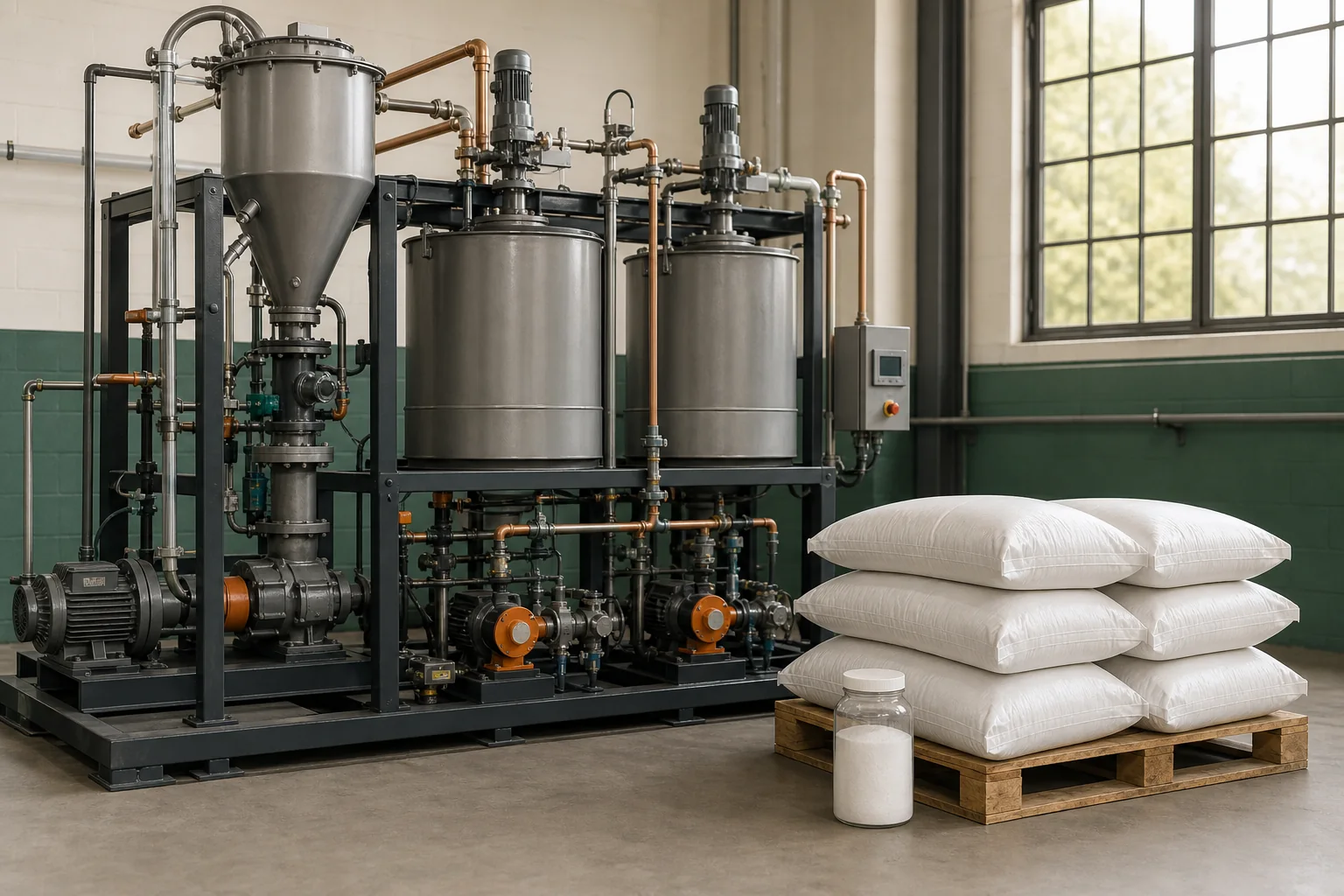
An anionic PAM pump setting is not a dose. A defensible mineral-slurry comparison converts actual polymer delivery and slurry dry-solids loading to the same time basis, then records the water and solids result.
Choose the dose basis
Clarification systems sometimes report product mass per water volume, while thickening and filtration commonly use active polymer mass per dry solids. State whether the result is milligrams per litre, grams per cubic metre, kilograms per metric ton dry solids or another unit.
Do not compare dry powder with emulsion on equal as-supplied mass unless active fraction and commercial basis are explicitly included.
Calculate dry-solids flow
Dry-solids mass flow equals wet slurry volumetric flow multiplied by slurry density and solids mass fraction. A solids value of 8 percent is entered as 0.08. Density assumptions can create material error in concentrated mineral slurry, so use measured mass flow or density where available.
Keep sample time aligned with the flow period. A daily average solids value may not represent a short polymer test during an ore or fines change.
Calculate active polymer flow
For a prepared powder solution, multiply actual solution flow by solution density and active mass fraction. A 0.1 percent solution uses 0.001 as the fraction. For emulsion or solution products, include the documented active fraction and inversion basis.
Secondary dilution water changes delivery volume and distribution but not active polymer mass. Calculate active delivery before the secondary water joins the line.
Calibrate the feeding system
Measure feeder or pump output over a safe defined interval at several setpoints and normal back pressure. Check water flow, powder feeder turndown, suction, pulsation, valves and day-tank concentration. Recalibrate after maintenance or concentration change.
A nominal make-down tank does not prove stock concentration. Verify dry feed, water feed and effective residence at actual demand.
Divide on a common time basis
Convert active polymer kilograms per hour and dry solids metric tons per hour, then divide. Keep all units on the worksheet so percent, minute-to-hour and metric-to-short-ton errors are visible. Report sensible precision based on measurement quality.
For water-volume dosing, divide active mass flow by treated-water flow over the same interval and state whether the figure is active or as supplied.
Use the number during a trial
Change dose in measured steps, allow solution and slurry residence, then sample overflow, underflow, filtrate or cake. Record throughput and mechanical settings. If solids flow changes, adjust delivery or recalculate actual dose for each result.
Compare inventory consumption with calculated daily use. Large disagreement can reveal feeder calibration, concentration, leakage or record errors.
Calculate total treatment cost
Multiply delivered product cost by actual as-supplied consumption, then include water recovery, throughput, filter cycle, sludge transport, cleaning and recycle impacts. The lowest active dose is not automatically the lowest operating cost.
Avoid false precision when solids, density and pump measurements are uncertain. Repeat close comparisons instead of declaring a winner from a difference smaller than likely error.
Minimum trial record
Keep date, feed source, slurry flow, density, solids fraction, stock concentration, calibrated solution flow, active dose, product lot, separator settings, stabilization time and endpoints. Send it with the sample trial and RFQ.
Worked calculation structure
Write the calculation as a chain rather than one unexplained result. Start with measured wet slurry volume per hour, density and solids fraction to obtain dry kilograms per hour. Separately calculate stock-solution mass per hour and multiply by active fraction. Convert dry kilograms to metric tons and divide active kilograms by that dry-ton flow.
Keep unit labels beside every value. Most large mistakes are percent conversion, volume-versus-mass, minute-versus-hour or metric-versus-short-ton errors. A worksheet that cancels units exposes them before a product-cost comparison is issued.
Manage changing solids load
A fixed pump setpoint produces a changing dose when feed solids drift. Where reliable measurement exists, pace polymer to dry-solids loading. Where it does not, define sampling frequency, an operating proxy and adjustment rules. Record the value used for each trial period rather than replacing it later with a daily average.
If slurry density is estimated, state the assumption and test sensitivity. Concentrated mineral feeds can make a water-density assumption materially understate dry mass.
Reconcile process and inventory totals
Compare calculated shift or daily consumption with bag, hopper or tote inventory over a meaningful period. Investigate large disagreement through feeder calibration, stock concentration, leakage, tank level and record time. The purpose is to find an error large enough to distort grade ranking and cost, not to force perfect accounting.
Keep both active and as-supplied dose on commercial records. Active dose supports technical comparison; as-supplied consumption supports ordering, freight and storage planning.