
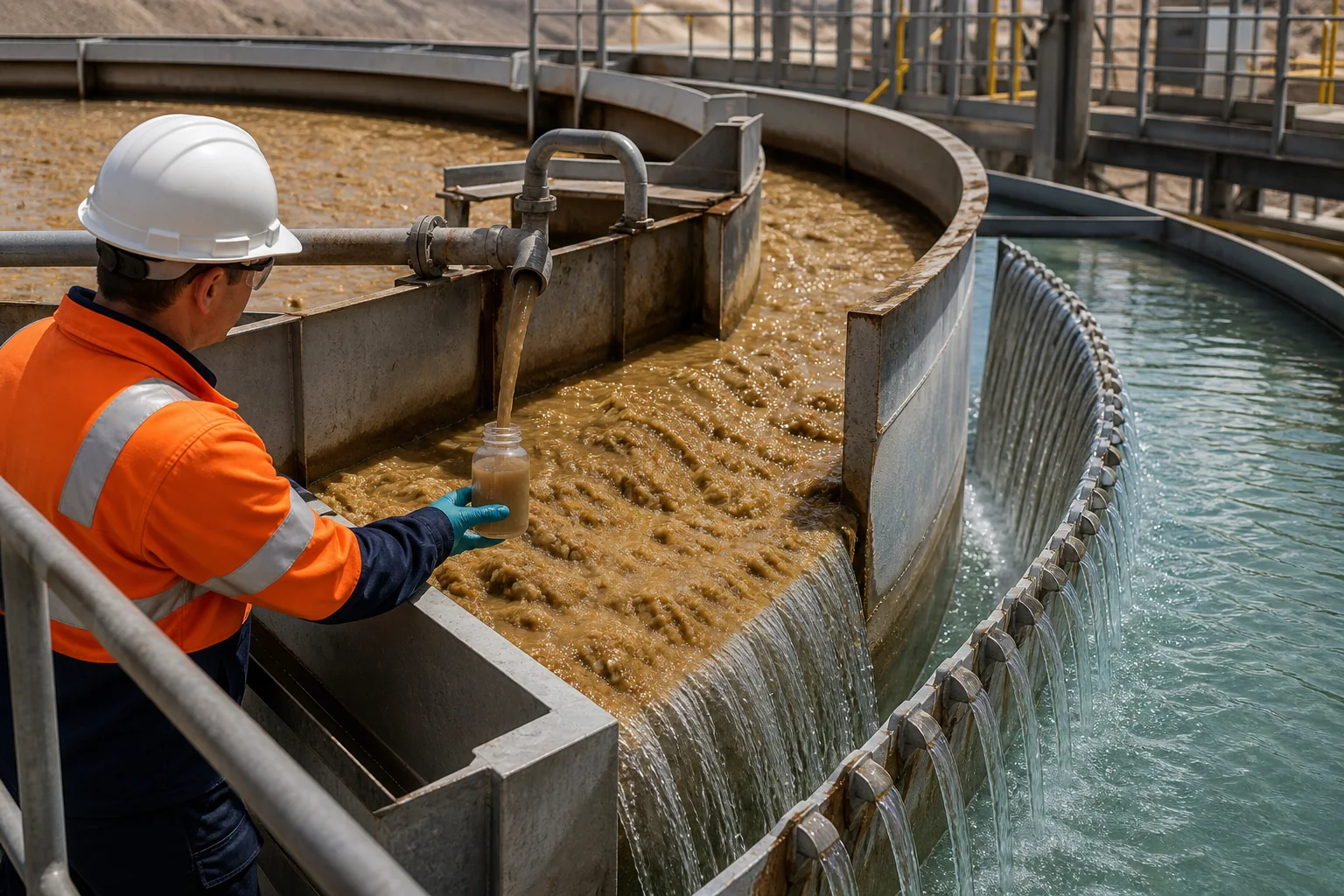
A tailings cylinder test should narrow polymer candidates and define a starting dose window for the thickener. It cannot reproduce every feedwell and rake condition, so the method must preserve representative slurry and collect measurements that scale meaningfully.
Collect the right slurry
Sample the combined tailings stream at a stable period and record ore campaign, flow, solids, particle size, pH, conductivity, hardness and reagents. Include recycle-water condition. If the circuit changes materially, collect more than one operating case.
Keep the fine fraction. Mix stored containers gently before splitting test portions, and avoid settling or decanting that changes solids distribution.
Prepare candidates on one basis
Use the same dilution water, active concentration, induction method, hydration time and solution age. Code samples where practical. Calculate added polymer as active mass per dry solids in the cylinder.
Choose a focused range that reveals underdose, useful zone and overdose. Include the present plant product as a benchmark and an untreated control.
Standardize mixing
Distribute polymer rapidly through slurry, then reduce energy for floc growth. Keep vessel geometry, volume, additions, time and movement consistent. If feedwell or pipeline shear is important, add the same defined challenge to every candidate.
Do not manually favor one cylinder with extra inversions until large floc appears. The test should compare products, not operator effort.
Measure settling and clarity
Mark the interface at consistent time intervals and calculate initial settling-zone velocity where appropriate. Record interface definition, supernatant turbidity or suspended solids and visible fines. Photograph the same times and background.
A very fast but diffuse interface can carry fines. A slower coherent interface may produce better overflow. Repeat finalists to understand variability.
Assess compaction and rheology proxies
Record final bed volume at defined times and observe whether sediment is loose, cohesive or difficult to remix. A cylinder cannot determine production underflow rheology, but it can reveal products that create bulky persistent beds.
Where available, use a suitable dynamic settling, yield-stress or filtration method after the initial screen. Keep the objective tied to plant underflow and pumpability.
Plan the plant confirmation
Begin below the bench optimum, verify stock preparation and injection distribution, and change dose in measured steps. Wait for transfer and thickener residence before sampling. Record overflow, bed level, rake condition, underflow density, throughput and recycle effects.
Do not change feedwell dilution, rake settings and polymer grade at the same time. Establish a chemical comparison first, then optimize combined operation.
Retain the decision record
Keep sample origin, water, solids, polymer and lot, preparation, active dose, mixing, interface data, overflow result, bed observation and plant outcome. Use it with the mining-tailings application brief for approval.
Control sample splitting and test order
Use a splitting method that preserves coarse and fine fractions across cylinders. Prepare enough homogenized slurry for the planned matrix and avoid repeatedly opening or remixing one container in a way that changes later jars. Randomize or bracket product order when settling during the session could bias the sequence.
Record cylinder dimensions and fill height. Interface velocity and visual bed comparisons are meaningful only when geometry and volume remain consistent.
Check the overdose boundary
Include a high point even when the first candidate settles quickly. Excess polymer may produce stringy light floc, cloudy supernatant, entrained water or slow compaction. Operators need to recognize those symptoms before the plant trial, especially when solids measurement or feeder calibration is uncertain.
A broad middle range is generally easier to control than a sharp optimum. Repeat that range on another ore or recycle-water condition before final sample approval.
Link the cylinder to thickener mass balance
Bench results should inform a plant starting condition, not promise throughput. At scale, solids flux, feedwell dilution, overflow, underflow, bed inventory and rake condition interact. Record dry solids entering, overflow loss and underflow withdrawal where instrumentation permits.
If polymer improves overflow while bed level rises or underflow becomes difficult to pump, the plant decision is incomplete. Review dose, dilution and architecture against both water recovery and solids removal.
Repeat the accepted condition after a meaningful ore, grind or recycle-water change. Keep the former test sheet as the comparison baseline and update the approved operating envelope only from measured plant evidence.