
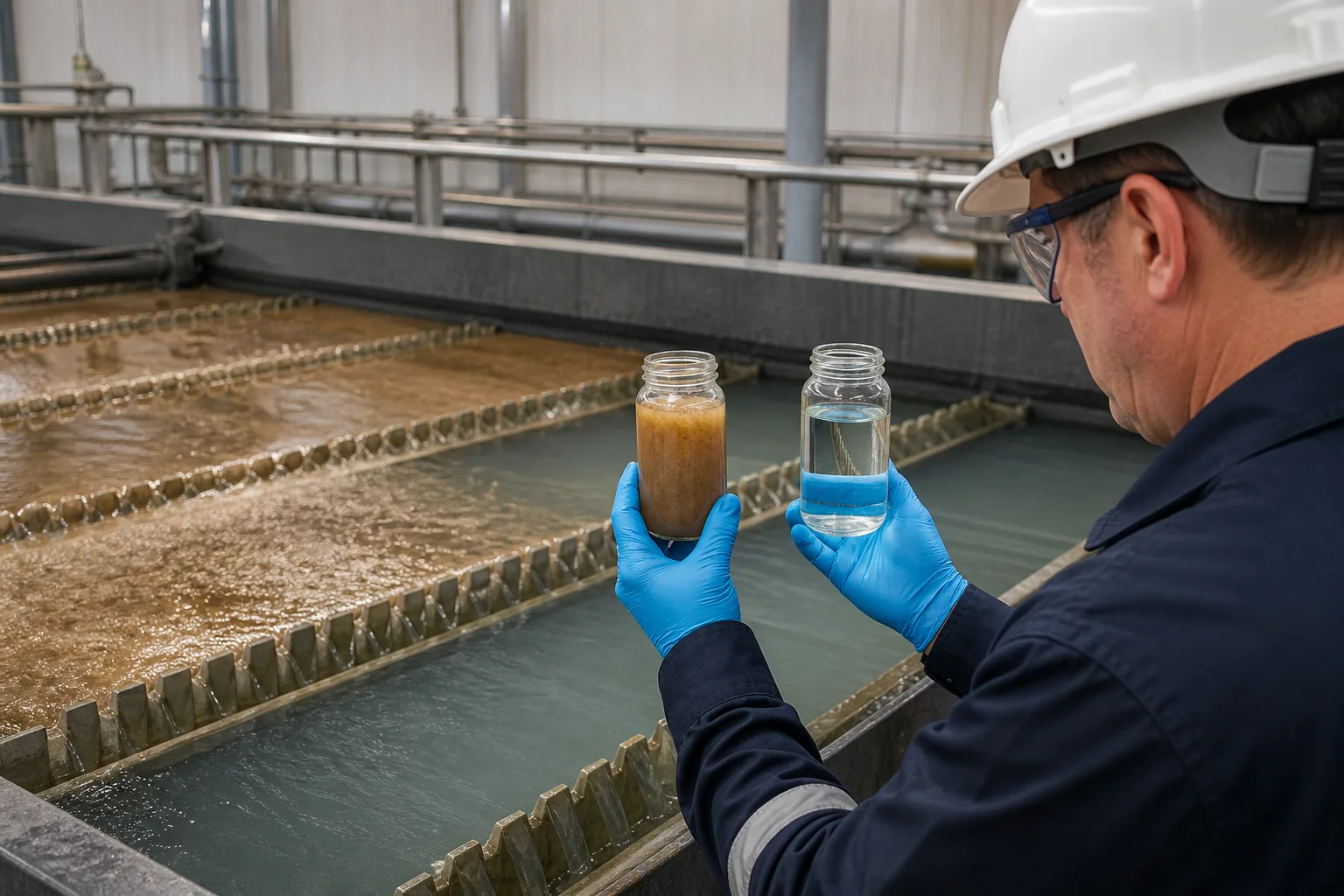
A coagulant-aid test must distinguish precipitation, coagulation and polymer bridging. Changing PAC, alum or ferric dose at the same time as anionic PAM makes the result impossible to attribute and difficult to reproduce.
Define the treatment target
Record wastewater or slurry source, pH, temperature, conductivity, raw turbidity or suspended solids and the regulated or process endpoint. For metals or phosphorus, measure the relevant dissolved and total forms where the decision requires them.
Visual clarity is a useful observation but not a substitute for the acceptance measurement. Also record sludge volume, settling time and downstream filtration where those affect cost.
Establish the pH and coagulant baseline
Run untreated controls and a structured pH or coagulant test before adding polymer. Choose a reasonable baseline that forms microfloc and approaches the treatment target without excessive chemical. Keep water volume, reagent strength, mixing and time constant.
Prepare fresh reagent solutions where the method requires them and document the as-supplied basis. Use separate pipettes or rinse procedures to prevent polymer contamination of control jars.
Prepare anionic PAM consistently
Make a dilute stock using controlled powder induction and gentle hydration. Record active fraction, concentration, water, temperature, mixing and age. Discard solutions with visible fisheyes or uncertain concentration rather than compensating with a larger dose.
Calculate the added mass for every jar. Equal milliliters are comparable only when every stock has the same active concentration.
Apply the chemical sequence
Add pH reagents and coagulant under the defined rapid mix. Allow the chosen formation time, then distribute anionic PAM quickly enough to contact all microfloc without prolonging destructive high shear. Follow with consistent gentle mixing and settling.
The exact speeds and times should reflect the plant and test apparatus. Report them so another operator can reproduce the comparison.
Use a dose curve and controls
Include a coagulant-only jar, several polymer doses and a deliberate high point. If multiple products are screened, first use a compact common dose set, then refine each finalist around its response. Repeat the best condition rather than relying on one jar.
Watch floc formation speed, size, strength, settling interface, supernatant, sludge volume and filtration. Improvement followed by haze or bulky weak floc can mark overdose.
Scale without losing the sequence
Confirm chemical addition points, pipeline residence, mixer energy and clarifier feed conditions. Calibrate pumps at operating pressure and convert the laboratory dose to active mass per flow or dry solids. Wait for plant residence time before sampling.
Change one variable at a time during the first plant run. Once a stable polymer point is found, refine coagulant and polymer together in controlled steps.
Retain the approval sheet
Record product code and lot, pH, coagulant, polymer active dose, mixing, settling, water result and sludge result. Connect the successful sequence to the industrial clarification application page and production RFQ.
Check the order of addition deliberately
Changing chemical sequence can change formed particle surfaces and floc architecture. If the plant may add polymer before, with or after a coagulant, test only plausible sequences and label every jar. Do not carry a successful laboratory order into production when plant piping reverses it. Map injection points and residence before scale-up.
When neutralization forms a precipitate, allow the defined reaction stage before the polymer step. Polymer added too early can become trapped in incomplete precipitate or mask an unstable pH condition.
Control sampling and measurement uncertainty
Collect supernatant from the same depth and at the same settling time. Avoid drawing through the interface or disturbing settled floc. Use clean vessels and the same turbidity, suspended-solids or analytical method for every condition. Report duplicate spread when close candidates may be within test variability.
If wastewater changes during the session, split one homogenized batch for the primary comparison or bracket the run with repeated baseline jars. Otherwise time-related feed change can look like a polymer effect.
Define plant stop and recovery points
Before a production trial, set acceptable pH, turbidity or regulated endpoint, blanket or sludge condition and chemical limits. Begin below the bench optimum, increase in measured steps and return to the last stable condition if overflow or equipment approaches a limit.
Document the residence delay from each pump change to the sampling point. A sample collected too early contains mixed treatment conditions and can cause operators to chase the dose in both directions.