
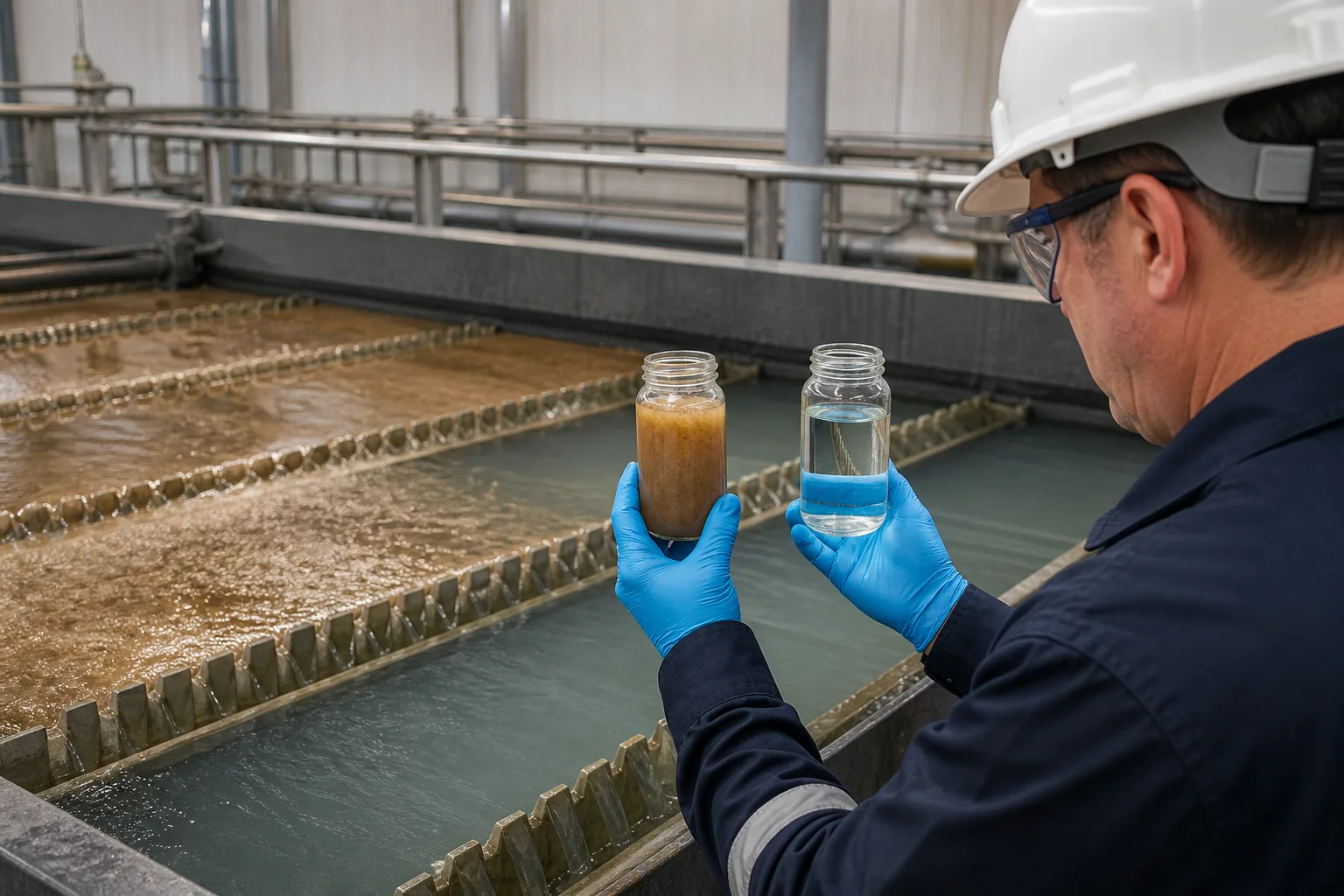
Industrial wastewater may form negatively, neutrally or positively charged solids after pH adjustment and coagulation. Anionic PAM is often screened as a bridging aid after metal salts create microfloc, but the sequence must be proven on the actual chemistry.
Stabilize precipitation first
Record wastewater source, batch or production stage, pH, conductivity, temperature, suspended solids and dissolved constituents relevant to treatment. Set neutralization and PAC, alum or ferric condition before comparing polymer.
If precipitation remains incomplete, extra polymer may enlarge visible floc without meeting dissolved-metal, color or other treatment limits. Polymer does not replace the required chemical reaction.
Use a two-stage jar-test matrix
First locate a reasonable coagulant and pH baseline. Keep it fixed while comparing anionic PAM candidates and dose. Then refine the combined condition in a small matrix. Apply repeatable rapid mixing, polymer distribution and gentle floc growth.
Measure the regulated or process endpoint rather than visual clarity alone. Include settling time, supernatant turbidity or suspended solids, sludge volume, filtration and chemical consumption.
Diagnose weak or reversed response
No response may indicate unsuitable charge, poor polymer solution, excessive shear or interference from surfactants and salts. Improvement followed by haze can indicate overdose or a shifted coagulation condition. Recheck blank and coagulant-only controls.
Test cationic or nonionic alternatives when evidence does not support anionic PAM. Product selection should follow the formed solids, not a fixed industry rule.
Prepare a useful enquiry
Send process, treatment sequence, pH window, coagulant, measured endpoints, equipment, current dose, quantity and destination. Use the coagulant-aid jar-test guide for the comparison sheet.