
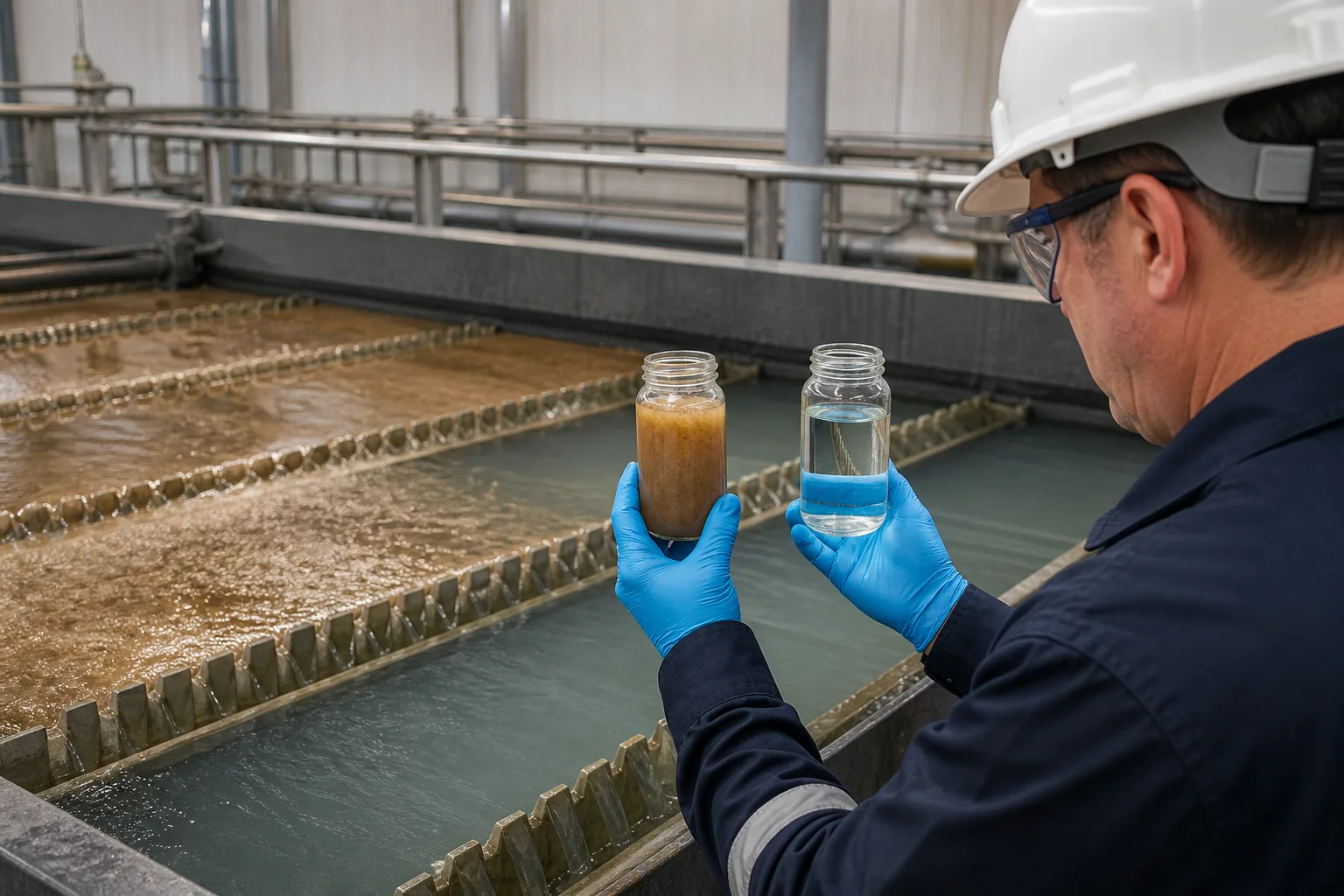
Scale-water clarification should be purchased as a defined solids-separation duty. Fine inorganic material and relevant upstream conditions determine the candidate screen. Anionic PAM does not by itself establish removal of every oil-related or dissolved constituent in a steel-mill water circuit.
Characterize the intended water stream
Identify the collection and treatment point, suspended solids and the relevant production variation. Include pH, conductivity, upstream reagents and oil-related observations where they affect the duty. Keep separate any treatment stage needed before polymer evaluation. A settled sample missing fine material is a poor representation of the clarifier feed. Explain the normal recycle condition rather than present one clean sample as the full water-quality envelope.
Establish upstream treatment before the polymer screen
Where pH control or coagulation precedes flocculation, hold that condition consistent during the comparison. Test candidate dose ranges using controlled preparation and mixing. The coagulant-aid trial method keeps treatment sequence and polymer contribution distinct. Do not use an apparent clarification benefit as proof that separate oil or dissolved-contaminant requirements have been met.
Measure clarification and residual handling
Record overflow suspended solids or other agreed endpoints, settling and sludge condition. Evaluate underflow pumping or filtration if those steps govern practical operation. The industrial clarification path connects bench results with installed residence, mixing and sludge handling. Large floc alone does not establish a good operating window, and a clearer overflow may be incomplete evidence if the collected residual becomes difficult to manage.
Approve the specific use and supply identity
Attach the candidate code, upstream treatment, water range and measured acceptance result to the order. Estimate demand on a clearly stated mass or flow basis. Confirm documents, packaging and delivery scope for the selected product. Production or treatment changes should trigger review rather than automatic extension of the qualification. No unrestricted reuse, discharge or residual classification should be inferred from the polymer trial.
Record the purchase decision
Complete the following checks with actual measurements, observations or an agreed document reference. Keep an untested condition visible as a limitation rather than assuming equivalence. The candidate code, sample identity and trial method must remain attached to the decision so purchasing and operations approve the same product and duty.
| Check | Evidence | Order decision |
|---|---|---|
| Stream | Solids, oil-related observations and upstream stage | Quote targets a specific clarification duty |
| Sequence | Fixed treatment baseline and controlled dose curve | Polymer contribution is interpretable |
| Approval | Water and residual-handling endpoints | Solids removal does not overstate broader treatment |
Send a useful sample and quotation enquiry
Provide scale-water source, fine-solids range, upstream process, water chemistry and relevant oil-related limits. Include clarifier and sludge-handling data, current product and measured dose. State the water-reuse objective and which acceptance results have been verified independently of visual clarity.
Include quantity, packaging preference and destination separately from the technical approval. Use the anionic PAM sample worksheet to define the candidate screen and confirm quality documents and delivered supply scope for the selected identity. Gongyi Xinqi Polymer Co., Ltd. can review the requirements. Availability, commercial terms and application suitability require confirmation; a process name does not establish a universal dose or guaranteed operating result.
Request a focused sample review
Send solids, water, separator and purchasing requirements for this duty.