
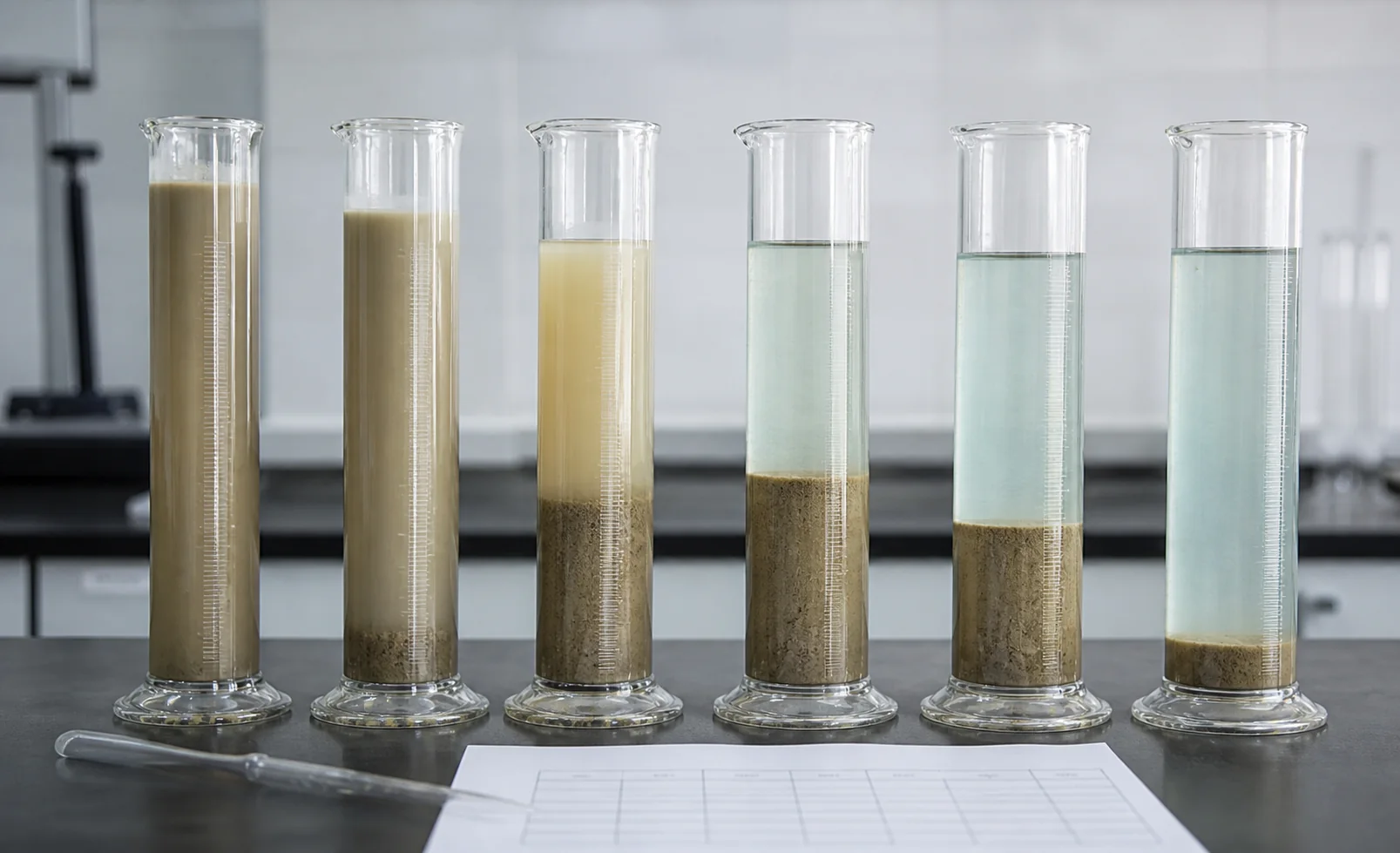
A kaolin wash-water enquiry must distinguish waste or recovery-water clarification from preserving a dispersed product slurry. Those are different objectives. Anionic PAM may be screened for a defined fines-separation duty, but it should not be added to a product circuit by assumption.
State the stream and intended result
Identify where the sample is collected and whether the objective is to recover water or manage a residual fines stream. Record dispersants, upstream reagents and relevant water chemistry. Keep the intended product-quality constraints separate from wastewater clarification. A clay sample with altered chemical history can give a misleading response. Provide the actual treatment stage so the supplier knows which particles are supposed to settle and which process remains outside the trial.
Check whether anionic bridging is justified
Compare a focused candidate range under controlled feed and preparation conditions. Where coagulation or another upstream step is used, establish that baseline first. A flat response is not a reason to assume that ever-higher anionic charge or dose will solve the duty. The coagulant-aid method helps distinguish the upstream particle condition from the polymer contribution. Other families may need comparison if the evidence does not support anionic PAM.
Judge recovery water and settled solids
Measure settling, water quality and compaction within a practical operating time. Include downstream sludge handling and any filtration objective. Rapid aggregation can leave a bulky bed or poor water result, so do not select from one visual observation. The thickening acceptance path keeps underflow and handling in view. A successful residual-water trial cannot establish compatibility with an unrelated kaolin product formulation.
Keep the approved duty explicit on the order
State stream identity, upstream treatment, candidate code and preparation with the accepted operating range. Estimate consumption from measured feed and a clear mass basis. Confirm relevant documents and packages for the qualified product. If dispersant use or stream routing changes, review the qualification. Avoid describing the purchase simply as kaolin polymer when that wording could permit application to the wrong point in the production circuit.
Record the purchase decision
Complete the following checks with actual measurements, observations or an agreed document reference. Keep an untested condition visible as a limitation rather than assuming equivalence. The candidate code, sample identity and trial method must remain attached to the decision so purchasing and operations approve the same product and duty.
| Check | Evidence | Order decision |
|---|---|---|
| Stream purpose | Residual/recovery water versus product dispersion | RFQ specifies which solids should be separated |
| Chemical baseline | Dispersants and upstream conditioning | Anionic response is established, not assumed |
| Acceptance | Water, compaction and handling results | Approval remains limited to the tested duty |
Send a useful sample and quotation enquiry
Provide the kaolin fines stream, its purpose, dispersant and upstream-treatment information, solids range and water data. Include separator, measured response and any product-circuit boundary. State clearly that the sample request concerns a particular recovery or residual-treatment duty.
Include quantity, packaging preference and destination separately from the technical approval. Use the anionic PAM sample worksheet to define the candidate screen and confirm quality documents and delivered supply scope for the selected identity. Gongyi Xinqi Polymer Co., Ltd. can review the requirements. Availability, commercial terms and application suitability require confirmation; a process name does not establish a universal dose or guaranteed operating result.
Request a focused sample review
Send solids, water, separator and purchasing requirements for this duty.