
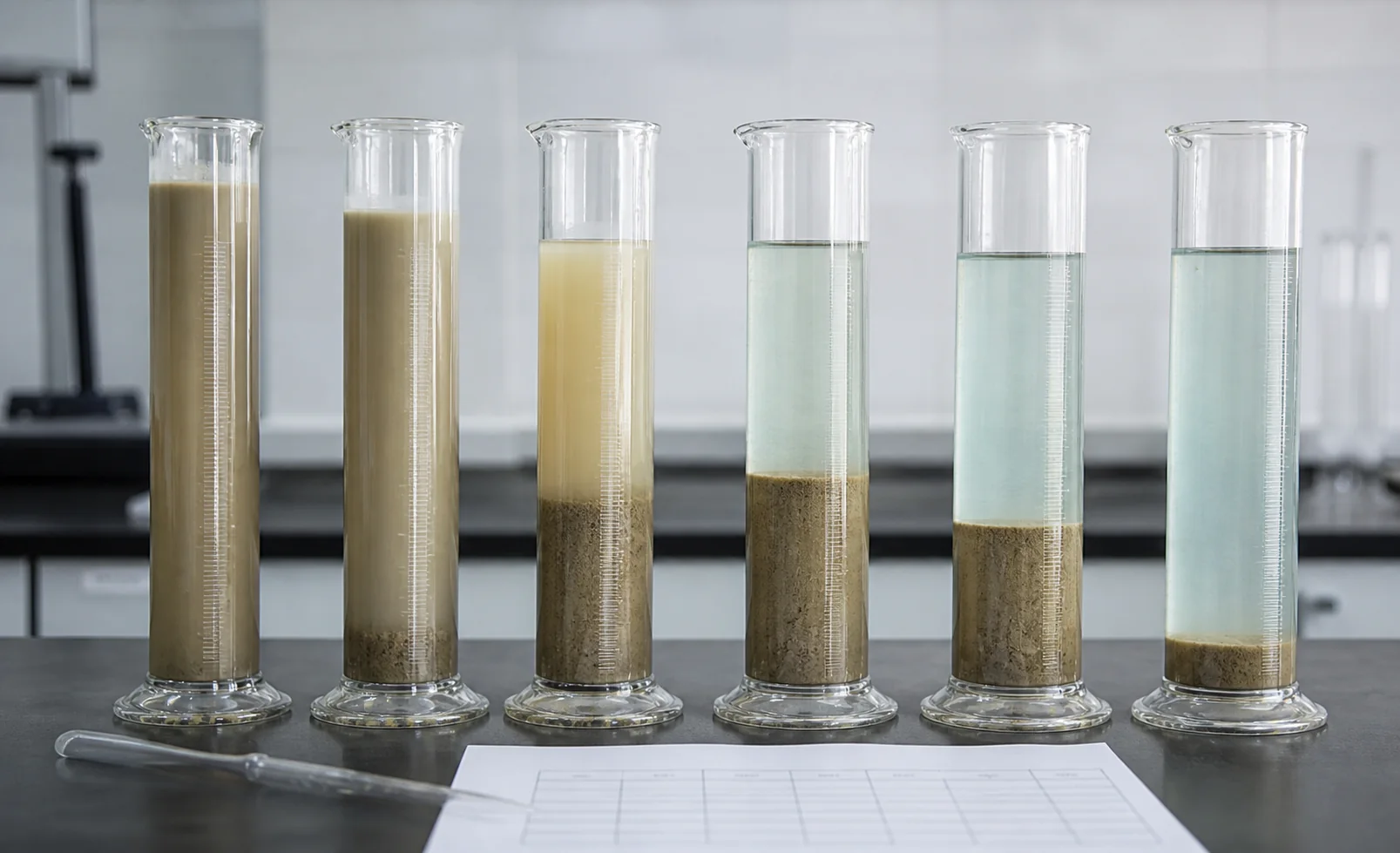
Clay-rich phosphate tailings need a feed-specific polymer screen. A rapid interface in a settling cylinder does not independently prove that a large volume of retained water can be managed at plant scale. Buy anionic PAM against the actual clarification and solids-handling evidence.
Represent the fine fraction accurately
Describe the tailings source and clay or fines information available. Record solids concentration, water chemistry and upstream treatment. Settling or poor splitting during sample handling can bias a comparison by removing the slowest fraction. Keep the sample procedure controlled and use a fresh representative material where the site process permits. Do not infer a fixed grade or dose from the word phosphate alone.
Evaluate more than initial settling
Measure interface movement, supernatant quality and final bed behaviour with consistent cylinder geometry and timing. Compare candidates at defined dose and preparation conditions. A product can rank well on initial settling but differently on compaction or handling. The tailings trial guide helps expose these differences without presenting a laboratory observation as a guaranteed large-scale result.
Keep architecture and operating limits visible
Charge, molecular characteristics and product form can affect the response. Ask suppliers to identify the selected candidate and relevant preparation information instead of treating all anionic powders as identical. If the circuit requires a specialized thickening or rheology objective, obtain a specific review. Use the paste-thickener purchasing checks where applicable; a general PAM label does not establish that more demanding duty.
Separate polymer approval from storage-facility design
Define the separator result, underflow transport and return-water objectives that the trial actually measures. Tailings placement and facility stability remain separate engineering responsibilities. Preserve tested feed conditions, product identity and dose range before committing to supply. Estimate order volume from qualified consumption and usable stock capacity. A purchase specification should state the evidence and its limits rather than promise a particular final tailings condition.
Record the purchase decision
Complete the following checks with actual measurements, observations or an agreed document reference. Keep an untested condition visible as a limitation rather than assuming equivalence. The candidate code, sample identity and trial method must remain attached to the decision so purchasing and operations approve the same product and duty.
| Check | Evidence | Order decision |
|---|---|---|
| Fine fraction | Representative splitting and clay information | Comparison retains the difficult solids |
| Response | Interface, overflow and bed behaviour | Fast settling does not conceal poor compaction |
| Approval limits | Separator and handling scope | No unsupported facility-performance claim |
Send a useful sample and quotation enquiry
Send the clay-tailings source, solids and water range, existing separator, preparation system and current consumption basis. Include timed settling and compaction observations. Identify whether clarification, thickening or a more specialized handling objective governs the sample request.
Include quantity, packaging preference and destination separately from the technical approval. Use the anionic PAM sample worksheet to define the candidate screen and confirm quality documents and delivered supply scope for the selected identity. Gongyi Xinqi Polymer Co., Ltd. can review the requirements. Availability, commercial terms and application suitability require confirmation; a process name does not establish a universal dose or guaranteed operating result.
Request a focused sample review
Send solids, water, separator and purchasing requirements for this duty.